


72% of companies found out that if you have less than 50 leads in your pipeline, it is difficult for you to be able to reach your revenue goals.
While most growing businesses focus on a specific number of deals at a single point in time, it is important to keep adding new leads or have quality opportunities in your pipeline consistently.
Sales pipeline management is the process of tracking and managing leads across different sales pipeline stages using a CRM system. Using a CRM tool such as Kylas helps to keep track of the leads in your pipeline and the stages they are in.
With the changing expectations of customers and increasing target pressures, sales teams need a sales pipeline management system that accelerates relationship building with customers, automates the sales pipeline, and helps close more deals faster.
Accelerating sales and converting the deals faster will require keeping the process clean and your leads consistently moving. This ensures your pipeline management system stays efficient and focused on high quality opportunities.
Here are some tips to accelerate your sales cycle.
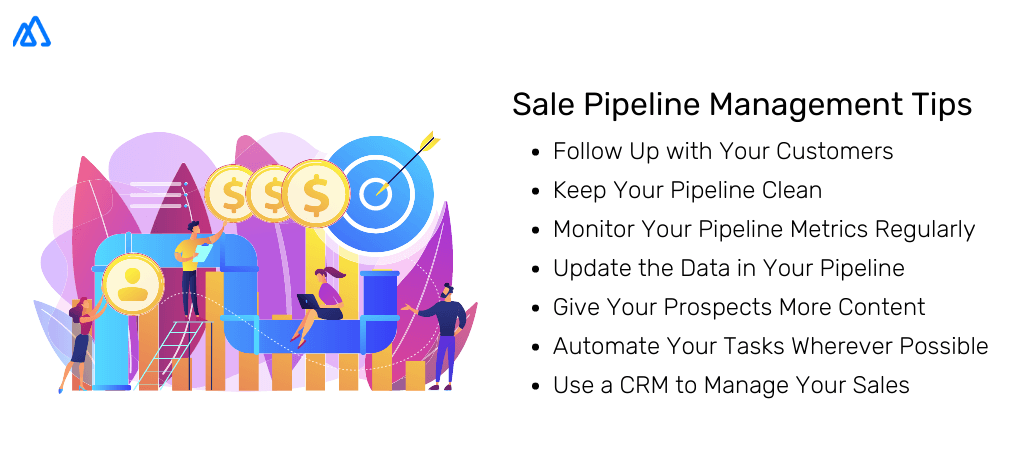
Sales Pipeline Management Tips
1. Follow Up with Your Customers
Following up can be tough, especially when customers today are flooded with more choices than ever before, it may take more than just a couple of follow-up calls to get their attention and close the deal.
That’s why one of the foremost tasks of an efficient sales rep is to keep following up with leads in order to convert. Consistent follow ups are essential for moving leads across different sales pipeline stages and improving conversions.
2. Keep Your Pipeline Clean
As crucial as it is to focus on high-value leads, it is equally important to remove the dead leads.
By dead leads we mean:
- Leads that have made it clear that they are not interested.
- Leads that cannot be contacted
- They have communicated but they do not return any of your attempts to nail them down and move forward.
Once you identify such dead leads and remove them, you can focus more on the next prospect without wasting any time on leads that simply don’t look promising enough.
A clean sales pipeline management system ensures your team focuses only on high intent leads.
3. Monitor Your Pipeline Metrics Regularly
The sales metrics in your pipeline are an indicator of how healthy your pipeline and business are. Tracking sales pipeline metrics helps businesses understand pipeline health and improve forecasting accuracy. Therefore, you must set some time aside on a weekly basis to monitor and check the key metrics in your pipeline such as:
- The number of deals in your pipeline
- The average size of the deals in your pipeline
- The average percentage of deals that you win (close ratio)
This weekly or monthly tracking will help you make relevant changes to your pipeline in order to close deals faster. Some of the best sales organizations do regular monitoring of their sales pipeline and strategies to make sure there are no bottlenecks and the processes are optimized for maximum conversions.
4. Update the Data in Your Pipeline
Apart from monitoring the leads and deals in your pipeline, one of the best ways to ace sales pipeline management is to ensure that the data in the pipeline is up to date.
For that add customer’s details, contact information, and notes at each and every stage of the pipeline so that there aren’t too many lost leads. Accurate data improves the effectiveness of your CRM for sales pipeline management and decision making.
5. Give Your Prospects More Content
As you move prospects ahead in the sales pipeline, relevant content can sometimes be the deal-breaker. Relevant content helps nurture leads and move them efficiently through each stage of the sales pipeline.
If you have no idea where to get started, here is a cue.
Listen to your customers during sales meetings. Take hints from the kind of questions they ask, such as ‘do you have a video that could explain this feature?’ or ‘is there a downloadable file that could explain more about your product?’
For each stage of the pipeline, give a thought to what kind of content you can provide to your prospects that will help reinforce your message and take them through to the next phase.
You can do so by getting your sales and marketing team to collaborate together.
6. Automate Your Tasks Wherever Possible
According to a Forrester report, automated tasks can help businesses save 90% of operational costs.
Automating your sales pipeline using CRM automation helps improve efficiency and reduce manual effort.
Tools such as Kylas Sales CRM can help you automate many manual tasks in your sales pipeline such as reminders for follow-ups, appointment scheduling, and making proposals, so your sales team can make the most of their time to ensure that the pipeline moves forward.
Using sales CRM software, you will be able to:
- Prioritize and score potential customers based on criteria such as position, industry type, and company size
- Set up workflows to automatically send emails individually and in bulk. You can even choose from existing email templates, and customize them with the help of CRM software.
- Allocate potential customers, company size, and estimated deal size by geographic location and industry type, making it easier and faster for sales representatives to contact potential customers
7. Use a CRM to Manage Your Sales
Staying updated and on top of all deals in your pipeline becomes quite easy when you have an efficient CRM in place.
Using a sales CRM in your pipeline strategy will help you avoid manual tasks and can save your growing business plenty of time. Companies that have used a CRM have found an increase in their sales by 29% on average.
For a minute, just imagine how smooth your sales process will become once you have the ‘pipeline view’ of your deals and you have the steps ahead. How many of those need a follow–up, and how many are converting?
Not only will a CRM automate several processes for you, but it’ll help you track metrics, easily manage leads and enable your team to quickly access the right information at the right time.
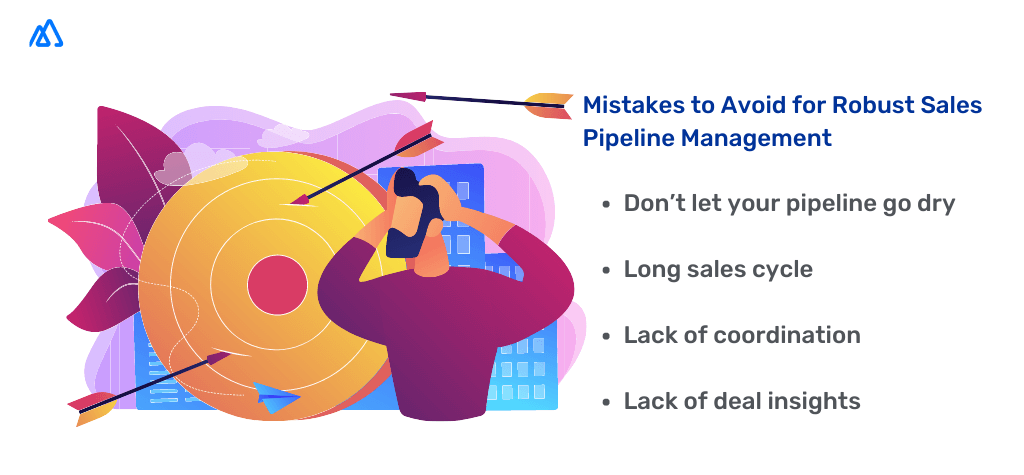
Mistakes to Avoid for Robust Sales Pipeline Management
Managing a robust pipeline is challenging; training individual sales reps to manage the data and the pipeline is even harder. In a world of leads, messages, texts, and increasing competition, it is quite easy for opportunities to fall through the cracks.
Here are the few most common pipeline mistakes that you can avoid. These common sales pipeline management mistakes can impact conversions, delay deals, and reduce overall pipeline efficiency.
1) Don’t Let Your Pipeline Go Dry

While a Sales pipeline is an indicative number of prospects or converted clients that your business might have at the moment, keeping a good repository of a good number of leads and deals in your pipeline is a good idea.
Ensuring your salespeople have more deals in their target will prevent your pipeline from running dry. A well maintained pipeline management system ensures a steady flow of qualified leads.
2) Long Sales Cycle

It is observed that lengthy sales cycles reduce the prospect’s desire to buy your product, especially if they have to jump through a lot of hoops.
Shorten your sales cycle and ensure there aren’t any hurdles in your sales pipeline. You can also identify which deals are taking longer than the others in your sales cycle and the right kind of efforts you need to put in for a quicker turnaround. Optimizing your sales pipeline stages helps reduce delays and improve deal velocity.
3) Lack of Coordination

Your lead may have to interact with multiple teams or departments in your organization in their buying journey. Hence, there is a potential for an error to occur during hand-offs from one team to another.
Often a lack of coordination among team members can result in a lost deal. Ensure that there is no miscommunication between teams and there is a smooth transition when the information is passed from one team to another. This coordination between team members helps the deals to flow faster through the sales pipeline. Using a sales pipeline CRM ensures better coordination and visibility across teams.
4) Understanding Customers

DIFFERENT PROSPECTS HAVE DIFFERENT REQUIREMENTS AND EXPECTATIONS.
Some may need more guidance and hand-holding than the rest, whereas others may seamlessly adopt your product. Understanding customer intent is critical for placing leads correctly within the sales pipeline stages.
It may happen that the salesperson focuses more on selling without providing the proper attention required by different prospects.
If the salesperson has not clearly understood the requirement of the customer, he may put the prospect in an incorrect stage of the pipeline; resulting in clogging of the sales pipeline.
Therefore, it is imperative to get an in-depth understanding of your prospect’s needs before pushing them through the sales pipeline.
5) Lack of Deal Insights

With multiple deals to look after and several follow-ups to track, your sales reps may lose sight of which deals to prioritize.
Your sales rep needs to keep track of follow-ups, if the lead has shown interest, the kind of activities that have happened recently, etc. In these cases, getting a CRM is the next best thing to do; it will not only help you make better decisions but also win more deals.
6) Focusing Only on One Stage

Monitor each stage with the same rigor. Focusing too much on one development at one particular stage of a deal will lead to losing track of the other deals in the pipeline.
Balanced attention across all sales pipeline stages ensures smoother deal progression and higher conversions.
Bottom Line
Modern pipeline management systems like CRMs help you get insights into the number of open deals, the status of each deal, and revenue generated.
A CRM is key to monitoring the performance of sales reps, getting reports on the distribution of deals among sales reps, organizing your pipeline, effectively tracking deals, and managing your team.
For example, a CRM such as Kylas is a robust free plan for unlimited users to help you manage leads, engage customers in live chat, and fosters collaboration. Sign up for a free account today.
FAQs
1. What is sales pipeline management in CRM
Sales pipeline management in CRM is the process of tracking and managing leads across different sales pipeline stages to improve conversions, visibility, and revenue.
2. What are the stages of a sales pipeline
Sales pipeline stages typically include lead generation, qualification, proposal, negotiation, and closing, helping businesses track deal progress and optimize conversions.
3. How does sales pipeline management improve sales performance
Sales pipeline management improves sales performance by organizing leads, tracking deal progress, monitoring sales pipeline metrics, and enabling better decision making.
4. Why is a CRM important for sales pipeline management
A CRM for sales pipeline management helps automate workflows, track deals, manage leads efficiently, and provide real time insights for better forecasting and conversions.
5. What are common sales pipeline management mistakes
Common sales pipeline management mistakes include poor follow ups, inaccurate data, lack of visibility, focusing on only one stage, and not using a proper pipeline management system.