


Before You Spend Another Penny on Your Ads, Fix These CRM Leakages.
I’ve spent over 20 years working at the intersection of marketing, sales, and technology — and through these years, one thing has remained constant:
Businesses don’t fail because of lack of tools. They fail because their systems don’t talk to each other.
I’ve been putting together my two decades of learnings into this Growth with Kylas series to help businesses grow the right way.
At Kylas, our purpose has always been to give small and medium businesses an unfair growth advantage — not just through technology, but through education.
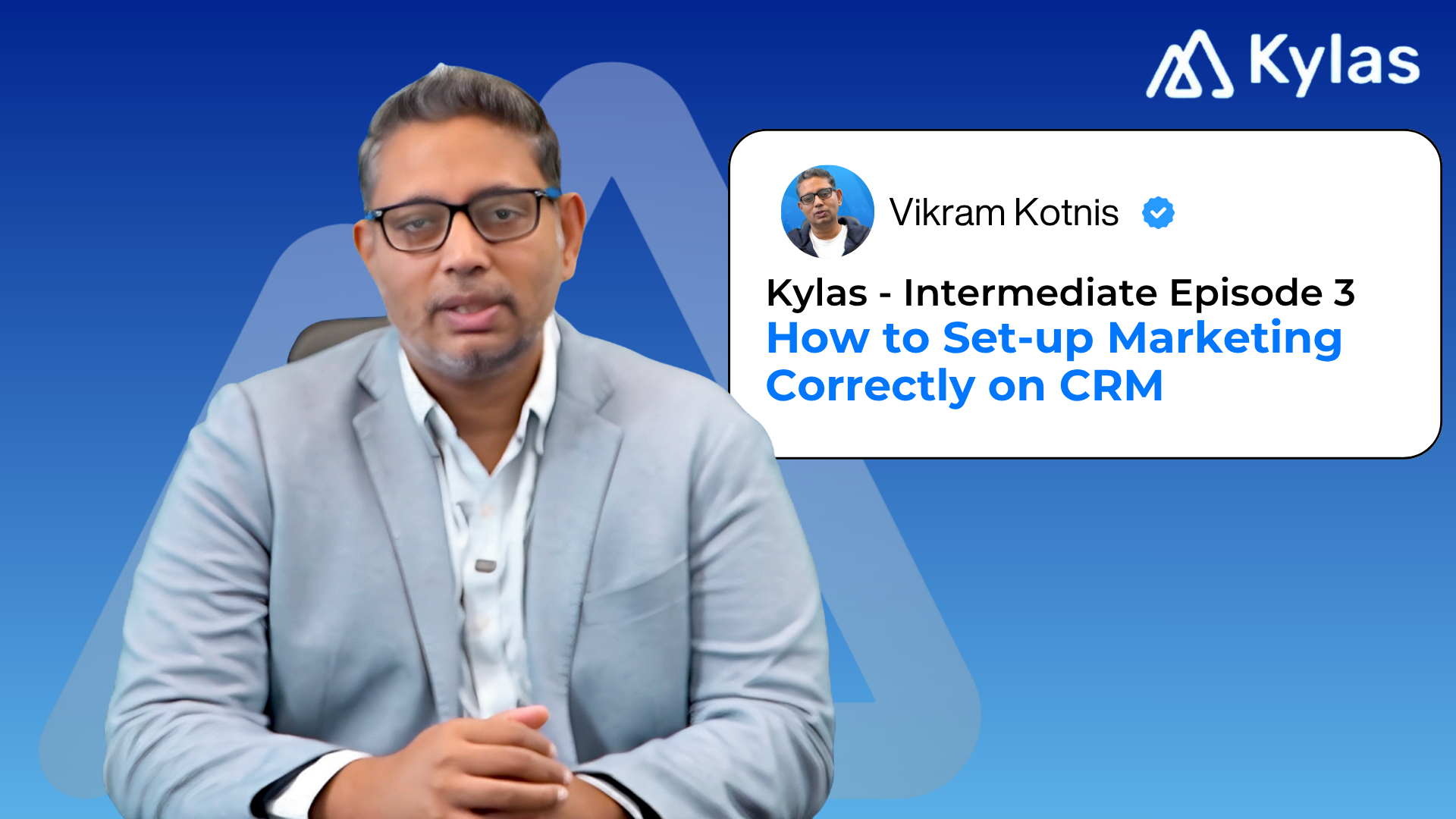
This episode is about how to set the right marketing process and how it reflects in your CRM — right from planning and execution to reporting and drawing insights.
And I don’t say this lightly — you will be able to make far better use of Agentic AI and automation if your team has first set the process correctly.
When your marketing, sales, and CRM systems don’t speak the same language, growth becomes chaos. That’s where SOPs change everything. So before you even start setting up your CRM, start by setting your Sales & Marketing processes right.
Together with our marketing partner Amura Marketing Technologies, we’ve created a complete set of Prompts and Frameworks for every business type — B2B, B2C, B2B2C, and E-commerce.
These are practical, customizable blueprints that help you:
- Build your Marketing Plan – campaigns, UTMs, and sub-campaigns
- Set up your CRM System – data structure, pipelines, and automations
- Track all your reports against forward-looking growth metrics
Each prompt is designed to help you scale like an enterprise — without the complexity.
DM us (Kylas) or reach out to Riddhi from Amura to get the ready frameworks that can help your business scale.
Why Processes Matter More Than Tools
Too often, I see businesses rushing to adopt new software, tools, or CRMs without taking the time to define the systems behind them.
But the truth is, a CRM is only as powerful as the processes that run behind it.
If you don’t define:
- How leads enter your CRM,
- How campaigns are structured, and
- How reports are tracked,
then even the most advanced platform will give you incomplete visibility and poor ROI. So in this blog, I’ll take you through a step-by-step breakdown of how to set up your marketing process correctly inside your CRM — beginning with Research, moving into Planning, and ending with Reporting and performance improvement.
Step 1: Research – The Foundation of Every Marketing Process
Before you can execute, you must understand. And that begins with marketing research.
Research is where your marketing process truly begins — not with ad creatives or budgets, but with data, intent, and insights.
This stage defines your market opportunity, your customer needs, and your competitors’ blind spots.
When done right, it ensures that every rupee you spend later is guided by insight, not assumption.
What Marketing Research Should Cover
Every business should start by answering three core questions:
Who are we talking to?
Identify your audience segments, their needs, pain points, and buying triggers.
Who are we competing with?
Analyze your competitors’ positioning, pricing, messaging, and market share.
Where is the opportunity?
Identify unmet needs, under-served geographies, and emerging trends.
Tools and Frameworks for Better Research
- SEMrush / Ahrefs: Find keyword intent and competitor visibility.
- Google Trends: Identify demand shifts by region or season.
- Mention.com: Track competitor mentions and market sentiment.
- AI-Powered Analysis: Use structured LLM prompts to connect data points and reveal opportunities.
Download the Kylas Marketing Research Prompt here:
Click hereThis framework helps you generate:
- Competitor positioning maps
- Keyword clusters by buyer intent
- Regional or segment-level opportunity insights
- Messaging direction based on data
This becomes the strategic foundation for everything that follows — your campaigns, automations, and reporting structure.
Step 2: Planning – Turning Research into a Marketing System
Once you’ve done your research, the next step is to structure it into a clear, executable plan inside your CRM.
At Kylas, we believe that planning is not just about what to do — it’s about how to make it measurable and repeatable. A good plan doesn’t live in Excel sheets; it lives inside your CRM, connected to real-time data and results.
Build a Hierarchical Marketing Framework
Inside your CRM, your marketing should flow in a clear structure:
- Campaigns – The overarching business goals (e.g., product launch, demand generation).
- Channels – The platforms used (Google, Meta, LinkedIn, Email, WhatsApp, IndiaMART).
- Activities – The specific actions under each channel (ads, landing pages, emails, remarketing).
For every campaign:
- Define your objectives and budget
- Set your UTMs for precise tracking
- Establish KPIs like CTR, CPL, or CPQL
The more granular you are at this stage, the more powerful your insights will be later.
Integrate Everything in Your CRM
Your CRM should become the command center for:
- Campaign creation and budgeting
- Channel integration (Google, Meta, WhatsApp, etc.)
- Lead source tracking via UTMs
- Nurturing automations and performance analytics
Download the Kylas Marketing Planning Prompt here:
Click hereThis template helps you:
- Create campaign hierarchies
- Define channel objectives
- Map activities to KPIs
- Align your marketing and sales objectives seamlessly
When your planning process is mapped into your CRM, execution becomes faster, collaboration becomes easier, and measurement becomes precise.
Step 3: Reporting – Measuring What Matters
Once your campaigns are live, your real work begins.
Because execution without measurement is like marketing in the dark.
The purpose of CRM-integrated reporting is not just to count leads but to connect every metric — spend, engagement, quality, and revenue — into one continuous feedback loop.
Organize Reporting by Funnel Stages
We recommend breaking your reports into three clear funnel layers:
| Funnel Stage | Key Metrics | Purpose |
| Top of Funnel | Impressions, CTR, CPL | Measure reach and lead generation efficiency |
| Middle of Funnel | CPQL, Cost per Demo, Conversion % | Track sales readiness and nurturing quality |
| Bottom of Funnel | CAC, ROI, LTV | Assess true profitability and campaign ROI |
When this data is visible in your CRM dashboard, you can immediately see:
- Which channels bring volume but poor quality
- Which campaigns deliver the best ROI
- Where leads are dropping or stagnating
Unifying Data Across Channels
Your CRM should merge:
- Ad Data: Spend, clicks, conversions
- CRM Data: Lead quality, deal velocity, closure rates
- Funnel Data: Lead → MQL → SQL → Deal → Revenue
This connected view gives you end-to-end visibility — from the first ad click to the final deal closure.
Download the Kylas Reporting & Analysis Prompt here:
Click hereIt helps you:
- Build performance dashboards
- Compare channel ROI
- Detect budget inefficiencies
- Align marketing and sales reporting
When you track what truly matters, your marketing evolves from reactive to intelligent — from gut-feel decisions to data-driven growth.
Bringing It All Together with Kylas
When Research, Planning, and Reporting work together, your marketing transforms from a series of activities into a connected growth system.
Inside Kylas, you can:
- Integrate all your lead sources (Google, Meta, LinkedIn, WhatsApp, IndiaMART, Email)
- Auto-assign leads to sales reps based on source or geography
- Automate nurturing sequences through WhatsApp and Email
- Access real-time dashboards showing lead-to-revenue conversion
With these processes, your CRM becomes your single source of truth — the bridge between marketing, sales, and business performance.
Final Thoughts – The Growth Formula
If there’s one thing I’ve learned while building Kylas and helping thousands of SMBs scale, it’s this:
Growth isn’t accidental — it’s engineered.
And that engineering starts with having the right process.
When you Research deeply, Plan clearly, Execute consistently, and Report relentlessly — your CRM becomes more than a database. It becomes your growth operating system.
Audit. Plan. Execute. Report. Repeat.
That’s the formula every business can adopt to create measurable, predictable, and scalable marketing success.
Get Started
- Download the Research Prompt:
Click here - Download the Planning Prompt:
Click here - Download the Reporting & Analysis Prompt:
Click here
Together, these templates form a complete Marketing Operating System inside your CRM — built to help you analyze smarter, execute faster, and grow more predictably.