

In today’s fast-paced B2C landscape, speed is everything. How quickly can your systems scale your business? Can you connect with your customers fast enough, personalize their journey, and convert them before they go elsewhere? These are crucial questions for any B2C business aiming for growth.
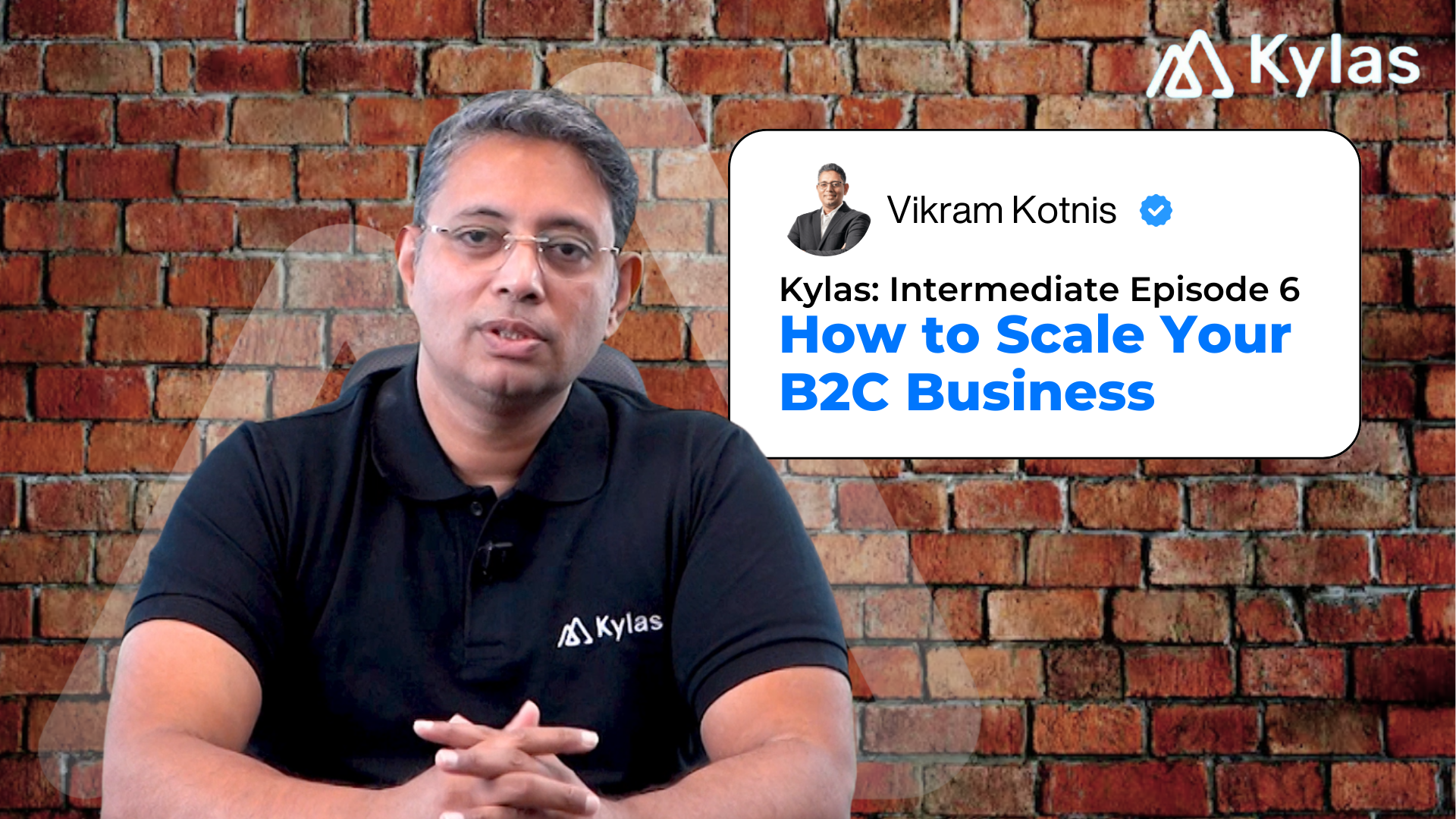
Hi, this is Vikram Kotnis, Founder & CEO of Kylas, and today, I’m going to walk you through how to scale your B2C business successfully with the right CRM setup. We will focus on how to make your processes efficient, fast, and automated — key components that drive growth for any B2C business.
The Speed Factor in B2C
In B2C, time is of the essence. The faster you can engage with customers, the better your chances of conversion. This is especially true for businesses in sectors like EdTech, Real Estate, Healthcare, Automotive, and Consumer Goods, where customers typically follow the ROPO model (Research Online, Purchase Offline).
Step 1: Organizing Sales Channels and Pipelines
The first step in setting up a B2C CRM is to properly structure your sales channels and pipelines. This is essential for tracking and managing leads as they progress through your sales cycle. At Kylas, we divide these into:
- Inbound Channels: These are leads generated from ads, website inquiries, and organic search (SEO). You can set up a pipeline for each lead source such as Facebook, Google, and direct website forms.
- Outbound Channels: These are leads that you generate by reaching out directly via telephony, emails, or even direct mail. You can structure these into separate pipelines for tracking cold calling, email outreach, etc.
- B2B2C Channel: For businesses with distributors, this is a pipeline where your sales process includes dealing with channel partners or resellers.
Each of these pipelines will allow you to map leads, set proper workflows, and automate follow-up actions based on the status of the leads, whether they are a suspect, prospect, or customer.
Step 2: Automating the Sales Journey with AI
Now that you’ve structured your pipelines, it’s time to automate your sales journey. The core idea here is to reduce the time between the first customer interaction and conversion.
At Kylas, we have automated workflows in place to reduce response time and increase efficiency:
- Automated Follow-Ups: Once a lead enters the system, AI and automation kick in to follow up with them through WhatsApp, email, or even through a voice agent, ensuring that no lead is ever forgotten.
- AI-Powered Lead Scoring: Every lead interaction is tracked, scored, and categorized based on its likelihood to convert. For example, if a lead responds positively to an email or a call, it is automatically flagged for immediate follow-up.
- Smart Segmentation: Kylas allows you to segment leads based on their activities. For example, if a customer visited a product page and filled in a lead form, the CRM automatically identifies them as an engaged prospect.
Step 3: Setting Up Clear KPIs and Forward-Looking Parameters
A big part of scaling your B2C business lies in tracking Key Performance Indicators (KPIs) that show the health of your business and where to focus efforts. In B2C, one of the most critical metrics is funnel velocity – how quickly leads move through the sales cycle.
In the case of automotive businesses, for instance, the forward-looking parameter might be a test drive; for real estate, it might be a site visit; for education, it’s usually a counseling session. Whatever that key action is, it should be defined upfront, as it helps prioritize sales efforts and determine the overall health of the sales funnel.
Step 4: Building a Seamless CPaaS Layer (Communication Platform as a Service)
Once you have your lead pipeline set up and automation in place, it’s essential to establish an efficient communication platform that integrates seamlessly with your CRM. A key feature of Kylas CRM is its integrated CPaaS layer, which helps track and manage every touchpoint between you and your leads.
For B2C businesses, WhatsApp, telephony, and email are the main channels for reaching out to customers. Kylas provides built-in functionality for these channels, ensuring that you have full visibility into every conversation. Key features include:
- WhatsApp Integration: Direct messaging with customers for quick follow-ups, campaigns, and feedback.
- Telephony Integration: Track calls, record conversations, and automatically log these into the CRM.
- Email Tracking: Know when an email is opened, clicked, and responded to, so you can prioritize follow-up actions accordingly.
Step 5: Implementing Automation to Handle Lead Volume
In B2C, especially when you’re dealing with high volumes of leads, automation becomes the backbone of your sales process. Whether you’re selling products, services, or managing a high-ticket item, automation is critical to prevent leads from falling through the cracks.
Kylas helps you automate the process with:
- Auto Call Setup: If a lead doesn’t respond within a predefined time, an automatic call reminder is set up for a follow-up.
- Email Triggers: If a lead hasn’t engaged in the system for a certain period, an email reminder or nudge is sent to re-engage them.
- Escalation Workflows: For leads stuck in one stage for too long, escalation workflows trigger alerts to the sales team or managers, ensuring quick action is taken.
Step 6: Personalizing Outreach Using AI
Personalization is critical for B2C success. Customers expect individualized experiences, and Kylas helps you achieve that at scale using AI. With our AI-driven CRM, every piece of communication can be personalized based on:
- Lead Behavior: AI scans interactions with your emails, website, and social media channels, tailoring your messages for maximum impact.
- Customer History: AI uses data on previous interactions, purchases, or inquiries to customize future communication, offering the right product at the right time.
Step 7: Leveraging Data-Driven Insights
Finally, to scale effectively, you need insights that allow you to fine-tune your processes continuously. Real-time reports and dashboards give you a 360-degree view of your sales, from lead acquisition to final conversion. With Kylas, you can track key metrics like:
- Conversion Rate: How many leads are turning into customers?
- Funnel Performance: Where are leads getting stuck? Are there drop-offs?
- Customer Acquisition Cost (CAC): What’s the cost of acquiring each customer? Is it sustainable?
These insights help you optimize every aspect of your sales process, from lead generation to final sales conversion.
Conclusion: Scale with Smart Systems, Not Just Hustle
To sum up, scaling your B2C business requires more than just increasing the volume of leads. It requires a smart, system-driven approach that includes efficient pipeline management, automation, AI-backed scoring, and data-driven decision-making. With Kylas CRM, we help you achieve exactly that — a streamlined, intelligent system that empowers your business to grow faster and more efficiently.
As the B2C market becomes increasingly competitive, only those who can move fast and make data-driven decisions will succeed. Let Kylas help you streamline your operations, optimize your sales process, and scale your business seamlessly.
Happy scaling, and happy selling!