


Artificial intelligence (AI) is no longer a buzzword on the edge of innovation. It is deeply embedded in how businesses sell, support customers, forecast demand, and make decisions. At the same time, a related concept has been gaining attention: Intelligence Augmentation (IA), also known as augmented intelligence or intelligence amplification.
If you are trying to understand AI, IA, the differences between AI and IA, and what this means for your business, this guide breaks it down in a practical, business-focused way.
What Is Artificial Intelligence (AI)?
Artificial intelligence (AI) refers to systems or machines that can perform tasks that usually require human intelligence – such as recognising patterns, understanding language, making predictions, or optimising decisions. These systems learn from data and improve over time through techniques such as machine learning and deep learning.
In business, AI shows up in:
- Recommendation engines on e-commerce sites
- Chatbots and virtual assistants
- Lead-scoring models in CRMs
- Fraud detection systems
- Predictive forecasting in sales and operations
Recent AI technology, especially generative AI, can generate text, images, code, and even synthetic data. Research by McKinsey & Company suggests that generative AI alone could add $2.6–4.4 trillion in value annually to the global economy, on top of the existing impact of AI.
In short, AI focuses on automation and autonomous decision-making: getting machines to do more of what humans used to do.
What Is Intelligence Augmentation (IA)?
Intelligence Augmentation (IA), also called intelligence amplification or augmented intelligence, is the use of technology to enhance human thinking rather than replace it.
The idea dates back to pioneers like J. C. R. Licklider and Douglas Engelbart in the 1950s–60s, who argued that computers should amplify human intellect, not mimic it.
Modern IA solutions might:
- Surface insights to a sales manager, but let them make the final call
- Suggest the next best actions to a support agent inside a CRM
- Highlight anomalies or risks to the finance team
- Assist doctors, analysts, or underwriters with decision support
A widely cited distinction in recent literature is that AI places the technology at the centre, while IA keeps humans at the centre and uses technology to support their decisions.
AI vs IA: Key Differences
| AI | IA | |
|---|---|---|
| Purpose | Automates tasks & decisions | Enhances human decision-making |
| Human Role | Human-out-of-loop (in many tasks) | Human-in-the-loop (always) |
| Strengths |
|
|
| Risks |
|
Dependent on human skill |
| Best For | Repetitive work, forecasting, analysis | Strategy, judgment, high-stakes decisions |
Both AI and IA rely on similar underlying technologies (machine learning, natural language processing, etc.), but they differ sharply in purpose, control, and role.
1. Goal
- AI: Automate tasks or decisions end-to-end with minimal human intervention.
- IA: Enhance human decision-making; the human remains the ultimate decision-maker.
2. Role of Humans
- AI: Humans design, train, and monitor the system, but in operation, the system may act autonomously.
- IA: Humans and machines work together; tools provide insights, humans apply context and judgment.
3. Risk & Accountability
- AI: If an automated model goes wrong (e.g., wrong credit decision, biased outcome), it can be harder to trace or correct without human oversight.
- IA: Humans stay “in the loop”, making it easier to apply ethics, domain expertise, and context.
4. Typical Use Cases
- AI use cases:
- Fully automated email classification
- Autonomous anomaly detection and blocking
- End-to-end underwriting or pricing in some scenarios
- IA use cases:
- Sales forecasting dashboards that explain drivers
- AI assistants for support teams
- Decision-support tools for doctors, executives, or analysts
You can think of AI as “Do this for me”, and IA as “Help me do this better”.
How AI and IA Work Together
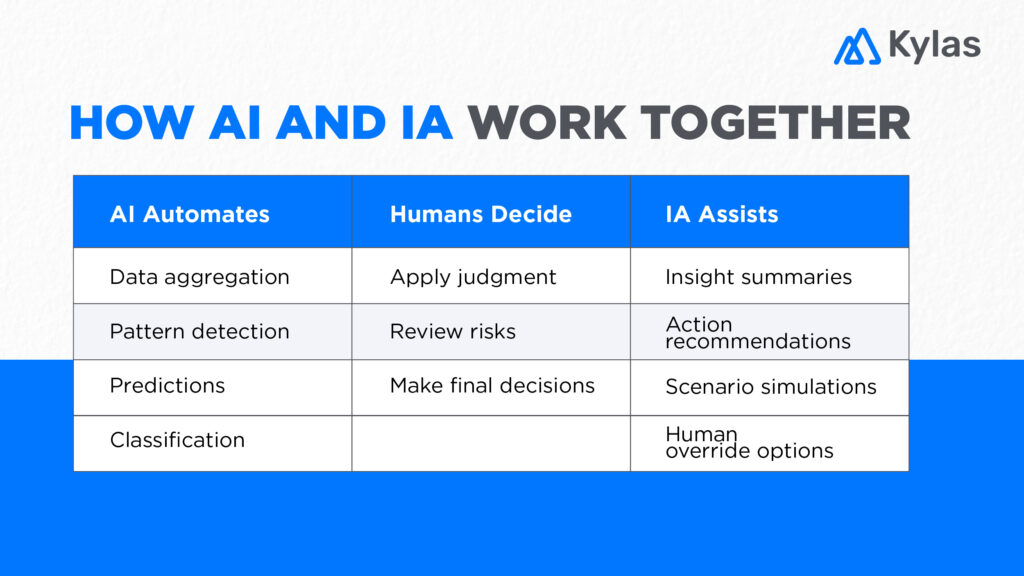
It is not AI versus IA in practice – they are often complementary.
A typical modern workflow might look like this:
- AI automates data-heavy tasks
- Cleans and aggregates large datasets
- Detects patterns or anomalies
- Runs predictive models at scale
- IA presents insights to humans in a usable form
- Explains key drivers or risk factors
- Highlights recommended actions
- Allows the user to simulate scenarios or override suggestions
- Humans make final decisions
- Apply domain knowledge and context
- Factor in qualitative information (relationships, strategy, ethics)
- Own the outcome and adjust the system over time
Research on human–machine symbiosis suggests that hybrid approaches (AI + IA) often outperform either humans or machines alone, especially in complex decision environments.
Benefits of AI vs IA
| AI | IA |
|---|---|
|
1. Scale and Speed
AI systems can process volumes of data and transactions that would be impossible for humans to handle manually, and do so in near real-time. |
1. Better Human Decisions at Scale
IA tools help people make faster, more informed decisions by surfacing relevant data, context, and recommendations at the right moment. |
|
2. Cost Efficiency
Automation of repetitive tasks (data entry, basic classification, routing, simple decisions) can reduce operational costs and free people for higher-value work. |
2. Retained Human Judgment & Ethics
Complex decisions often involve ethics, long-term brand impact, or nuanced trade-offs. IA respects this by supporting human judgment rather than replacing it. |
|
3. Pattern Recognition and Prediction
AI excels at spotting patterns in complex datasets – from customer churn risk to fraud detection – and can recommend proactive actions. |
3. Higher Adoption and Trust
Employees are often more comfortable with tools that support them than tools that replace them. This can lead to higher adoption and more responsible use of AI capabilities. |
|
4. Productivity & Revenue Impact
Surveys from McKinsey show that a majority of organisations using AI report revenue increases in key business functions, and many plan to increase AI investments further. |
4. Resilience and Flexibility
When conditions change (new regulations, market shocks, customer shifts), human decision-makers can adapt quickly, while IA systems continue to provide relevant insights and structure. |
|
5. Enablement of New AI Technology
AI foundations (models, infrastructure, data pipelines) enable new AI technology such as generative AI, which powers conversational assistants, smart content generation, and advanced analytics for sales and marketing. |
5. Reduced Risk of “Black Box” Automation
IA keeps humans in the loop, which can help reduce the risk of blind trust in opaque AI models and improve oversight, especially in regulated industries. |
AI vs IA: Which Is Better for Businesses?
Framed as AI vs IA, it is tempting to ask which one to “choose”. In reality, most mature organisations blend both.
A useful way to think about it:
- Use AI wherever:
- Tasks are repetitive and rule-based
- The cost of errors is relatively low
- Speed and scale matter more than nuance
- There is enough data to train reliable models
- Use IA wherever:
- Decisions are complex, high-impact, or regulated
- Human expertise and relationships matter
- Context changes frequently
- You need transparency, explanation, and control
For example, a sales organisation might use AI to score leads and forecast pipeline, while IA surfaces these insights inside the CRM so sales leaders can adjust strategy, coach teams, and prioritise deals.
Consulting and industry reports also suggest that companies getting the most value from new AI technology are those that redesign workflows around human + machine collaboration, not just full automation.
How AI and IA Show Up in Everyday Business Tools
In practical terms:
- A CRM system with AI-generated lead scores, opportunity health indicators, and win-probability metrics is using AI.
- When that same CRM presents those insights to the sales team with clear explanations, recommended actions, and room for manual overrides, that is IA in action.
Modern business tools – including CRM platforms like Kylas – are increasingly embedding AI features in ways that feel more like Intelligence Augmentation than pure automation. The aim is to help sales teams, marketers, and support agents work smarter, not just faster.
Is Intelligence Augmentation the Future of AI?
Many researchers and practitioners believe that the future of AI is deeply tied to IA, not opposed to it.
Academic and industry literature increasingly frames augmented intelligence as the path to:
- More responsible use of AI
- Better human–machine collaboration
- Higher trust and transparency in decision-making
In other words:
- AI will continue to advance and automate.
- IA will determine how well organisations actually use AI – and how comfortably people work alongside it.
For businesses, the strategic question is shifting from “Should we use AI or IA?” to:
“Where should we automate, and where should we augment our teams?”
Organisations that answer this well – and design workflows around the right balance – are the ones most likely to turn AI from a buzzword into a genuine competitive advantage.
Final Thoughts
Understanding AI vs IA is no longer a theoretical exercise. It directly influences:
- How do you design customer journeys
- How your sales and support teams work
- How leaders make decisions using data
- How safely and effectively you adopt new AI technology
AI gives you the engine.
IA ensures your people know how to drive it well.
If you are evaluating tools or platforms for your business, look for solutions that not only automate but also augment: surfacing the right insights, at the right time, in the right workflow.